February 22, 2021
Lazy Evaluation
What & Why
Most languages evaluate arguments before passing them to a function. Lazy evaluation flips this: don’t compute anything until you actually need the result. This small change has surprising consequences. Consider the following example from SICP:
(define (try a b)
  (if (= a 0) 1 b))
Using the basic evaluator, (try 0 (/ 1 0)) will raise an error as the denominator cannot be 0. However, with lazy evaluation, there would be no error at all! Evaluating the example would return 1, as the argument (/ 1 0) would never be evaluated: the evaluator promises (/ 1 0) to be evaluated until it is actually used. We call languages with lazy evaluation as normal-order languages. Also, we say a procedure is non-strict in an argument if the argument is not evaluated before the body of the procedure.
Another example of lazy evaluation is short-circuit evaluation:
false && (true || false && true)As we have the logical operator and here, any part being evaluated to false will lead to the whole expression being false. Thus, lazy evaluation will only look at false and skip (true || false && true).
From the above example, we can say that sometimes lazy evaluation can help reduce error, and we could save (perhaps loooong) evaluation time of an operand never needed in the body of a procedure. Popular languages like Python also integrate lots of lazy evaluation functionalities. We will see more pros and cons of lazy evaluation at the end of this post.
Two Implementations of Lazy Evaluation
There are two implementations of lazy evaluation: call-by-name and call-by-need. Before we dive deeper into that, let’s introduce a new concept called thunk. The idea is that, argument evaluation is going to be delayed when applying a procedure. The delayed arguments will be transformed into objects called thunks, which contain necessary information to produce the value of the argument. That being said, a thunk must contain the argument expression and the environment when the procedure is being called. In other words, a thunk is a shell for a delayed expression. The following list can represent a thunk:
(list 'thunk exp env)Thunk is an important object in implementing lazy evaluation. The process of forming a thunk is called freezing, or delay. The process of evaluating a thunk is called thawing, or forcing. When we want to evaluate thunks, we can memoize the value of the argument, or evaluate the same thunk again in the future. This leads to two different implementations of lazy evaluation:
- call-by-name: invokes thunk every time parameter is referenced; disadvantage: it is a waste of time when side-effects are not possible because the same value is returned each time
- call-by-need: records the value of each thunk the first time it is called, and thereafter refers to the saved value rather than re-invoking the thunk; this is an example of a more general technique called memoization, which is also used in dynamic programming
In other words, call-by-name is non-memoized lazy evaluation, while call-by-need is memoized lazy evaluation.
Useful Scenarios
Stream Object
With call-by-need, we could implement a stream abstraction. A stream object is a pair-like object, except the cdr part is not evaluated until needed. Thus, the data structure may be infinite!
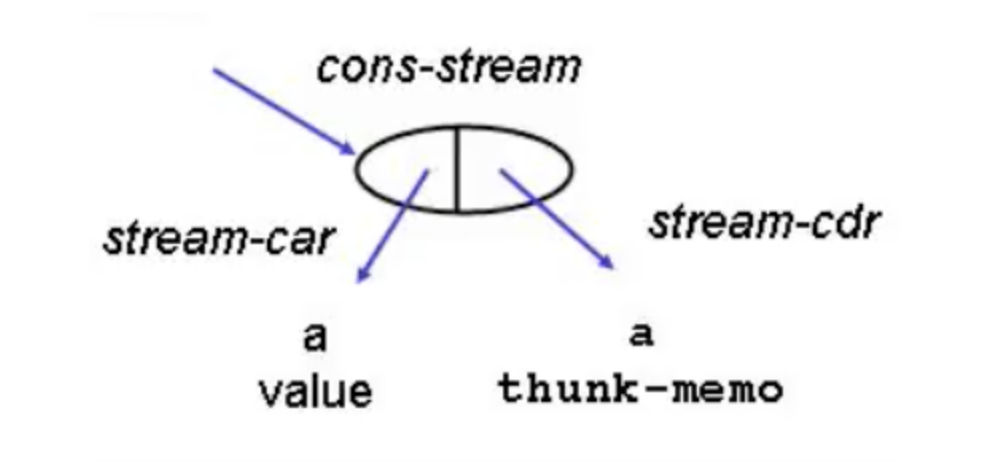
Suppose we want to find the first 100 prime numbers between 1 to 100000000, without stream object, the procedure will look like:
(list-ref
  (filter (lambda (x) (prime? x))
          (enumerate-interval 1 100000000))
  100)
This can be costly as we need to generate the entire list of integers from 1 to 100000000 before proceeding. Stream object can save us from generating a huge list. First, we define two helper procedures:
;; generate a stream list, which is lazy
(define (stream-interval a b)
  (if (> a b)
      the-empty-stream
      (cons-stream a (stream-interval (+ a 1) b))))

;; filter out elements satisfying the predicate in stream
(define (stream-filter predicate str)
  (if (predicate (stream-car str))
      (cons-stream (stream-car str)
                   (stream-filter predicate
                                  (stream-cdr str)))
      (stream-filter predicate (stream-cdr str))))
Then we have the improved version:
(stream-ref
  (stream-filter (lambda (x) (prime? x))
                 (stream-interval 1 100000000))
  100)
stream-interval promises to generate the numbers between 1 to 100000000, but once the first value is generated, it is immediately passed to stream-filter. Then stream-filter will ask for the next element in the stream. The program will now go back to stream-interval for the second number, etc. As a consequence, we just need to find the first 100 prime numbers and exit the procedure using stream-ref now!
yield in Python
Here is another similar example in Python.
We are used to writing code like createIterable. This can be troublesome when the list size is so large that the performance of programs may be compromised. The keyword yield can solve this by following the principle of laziness. createGenerator will not return an actual element until it is forced to “yield” one. In other words, when you call the function, the code you have written in the function body does not run. Thus, createGenerator processes i=0, and takes a break until the next element in the generator is asked. Because of its laziness, what yield returns can only be used once, while an iterable list can be iterated multiple times.
# return a list as a whole
def createIterable():
    mylist = []
    for i in range(3):
        mylist.append(i*i)
    return mylist

for i in createIterable():
    print(i)  # print 0, 1, 4

# yield elements one by one
def createGenerator():
    mylist = range(3)
    for i in mylist:
        yield i*i

for i in createGenerator():
    print(i)  # print 0, 1, 4
More about Lazy Evaluation
Pros:
- Saves the work required to evaluate an unused argument and sometimes prevents an error
- Leads to a uniform language; no need for special syntactic forms (e.g.,
if) - Language can be extended by programmers in standard ways
Cons:
- Call-by-name can be inefficient if an argument is used more than once in the body (so use call-by-need version then)
- Call-by-need makes a program difficult to understand in the presence of side-effects
Other applications of lazy evaluation:
- Same-fringe problem
- Combinatorial search (e.g., a tree) in AI
- Lends itself to straightforward implementation of important recursive algorithms (e.g. quicksort)
- Overall, streams and filters are used in concert in a generator-filter style of programming
Other Laziness in Computer Science:
- Caching: keeping copies of data around
- DevOps: automating the deployment and maintenance cycle
- Documentation: writing great documentation about your code so that others won’t bother you